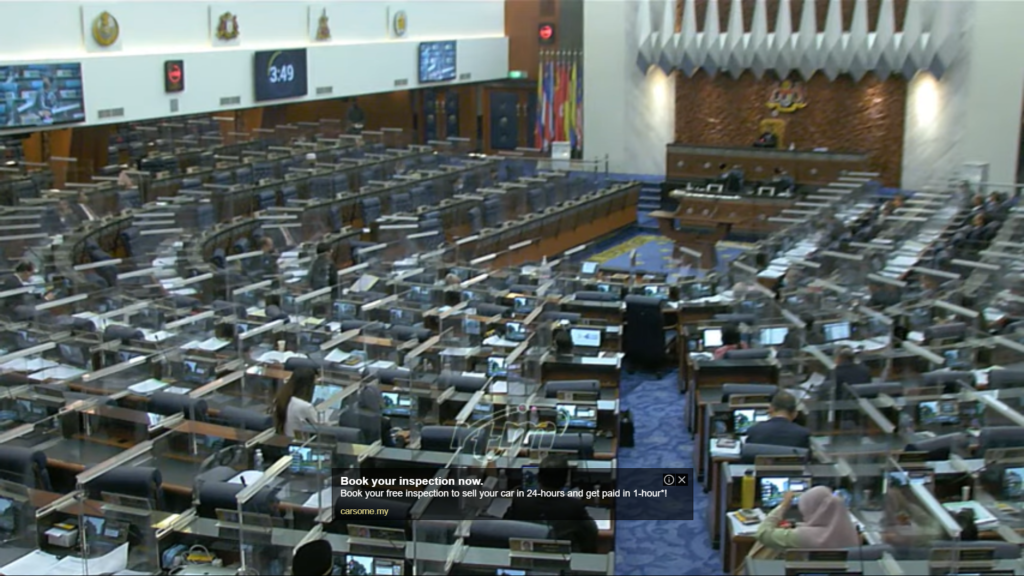
PETALING JAYA: Political leaders must stop the dilly-dallying and introduce and asset declaration law applicable to all Members of Parliament, which provides a clear framework for declaration and public access to this information.
Making this call today, the Center to Combat Corruption and Cronyism (C4 Center) said a binding and comprehensive asset declaration law will ensure transparency and accountability, and combat corruption at a structural level.
“Thus, political leaders who continue to delay or question the development of such a framework should remember that they are obstructing the development of good governance and anti-corruption measures,” C4 Center said in a statement today.
Recent comments from several political figures display a stunning paucity of urgency in this regard:
- Opposition leader Hamzah Zainuddin questioned asset declaration requirements for MPs without executive responsibilities, stating that wealthy MPs could become targets without the protections afforded to ministers; and
- PAS deputy president Tuan Ibrahim Tuan Man echoed the concern of security risks “in today’s age of open media and widespread misinformation”, stating that the party supported asset declaration requirements for those with access to government resources.
On the other hand, other leaders such as UMNO Supreme Council member Puad Zarkashi and Pasir Gudang MP Hassan Abdul Karim have voiced their support for mandatory asset declarations for all elected representatives.
This is a position that needs to be adopted by all political figures and lawmakers, for the risks of political financing are not limited to those in Cabinet alone, C4 Center said, adding that a comprehensive asset declaration law should include all MPs, senators, and state assemblypersons.
Article 8(5) of the United Nations Convention against Corruption (a universally binding anti-corruption instrument which Malaysia ratified in 2008 and is thereby bound) stipulates that State Parties shall endeavour “to establish measures and systems requiring public officials to make declarations to appropriate authorities” regarding their investments, assets and substantial gifts or benefits from which a conflict of interest may arise. Presently, Malaysia still does not have any statutory requirement for mandatory asset declaration by elected officials.
The previous National Anti-Corruption Plan 2018-2023 (NACP) listed a mandatory asset declaration framework for all MPs as a strategic goal. During a mid-term review in 2021, initiative 1.2.9 of the NACP was subsequently amended from, “To introduce a written law on the declaration of asset and interest by Members of Parliament” to initiative 1.2.6, “To undertake a study on the viability of a written law on asset declaration by Members of the Administration and Members of Parliament”.
The National Anti-Corruption Strategy 2024-2028 (NACS) which replaced the NACP removed any mention of an asset declaration law, including under the appendix titled “NACP Initiatives That Could Not Be Completed as of December 2023”. Instead, the NACS only makes mention of introducing an interest and gift declaration mechanism under Sub-strategy 2.12, “To introduce a mechanism for declaration of interest and gift by members of the administration and members of Parliament.”
Asset declaration is an important element of open government policies, as it allows for increased transparency of the financial positions of those in power. The public availability of such information enables members of civil society to also serve as watchdogs to monitor potential instances of illicit enrichment and corruption.
Concerns about security risks can be alleviated by redacting identifiable information (such as locations of real properties), but this cannot be justification to not publicly release declared information. The public deserves to know whether their elected representatives have enriched themselves during their time in office, and any political figure who cannot see this should remind themselves of the depth of public discontent in the current political landscape.
–WE