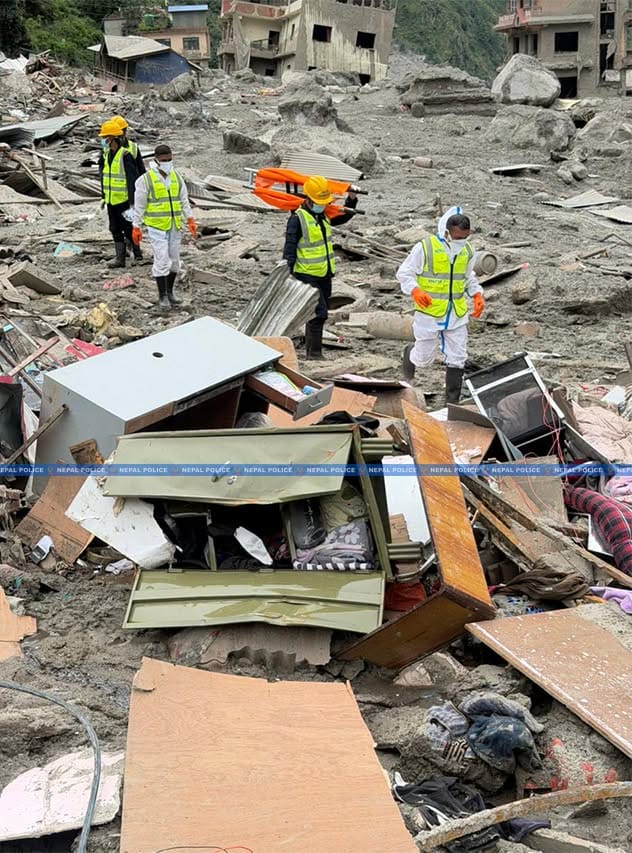
ISTANBUL, Sept 2 (Bernama-Anadolu) — The devastating flash floods and mudslides that struck the Himalayan border region between Nepal and China should serve as a “wake-up call” for countries in the region, an expert in critical geography told Anadolu Ajansi.
The warning came as the death toll from the Aug 26 disaster rose to 1,130 on Wednesday, while search operations continued for nearly 4,500 missing people a week after the disaster.
“Such a disaster is inevitably coming always in the dynamic glacial and seismically active environment of the high Himalayas and the Karakorams,” Daanish Mustafa, professor of critical geography at King’s College London, told Anadolu.
The disaster struck last Wednesday when a glacier on Nepal’s Mount Langtang Lirung fractured at an altitude of about 5,200 metres (17,060 feet), triggering an ice-rock avalanche that developed into a massive debris flow and swept through valleys along the border.
The surge of water and mudslides devastated Rasuwa, Nuwakot, Dhading, Kavre and the Kathmandu Valley in Nepal, while also burying the Gyirong border crossing with Nepal in southwestern Tibet, also known as the Xizang Autonomous Region, on the Chinese side.
“This was a most unfortunate incident and sadly it was not preventable,” Mustafa said.
Of the 3,916 people missing on the Nepalese side of the border, 639 are personnel deployed at hydropower projects across the landlocked country.
“Dams in high mountains simply work to amplify and accentuate the damage from such events. It should be a wakeup call to all the countries, especially India, China and Pakistan who are in the process of building large dams in the environment,” Mustafa said.
China’s Foreign Ministry said Wednesday that the disaster was “caused by glacier instability resulting from the long-term effects of climate warming.”
“An ice-rock avalanche occurred at a glacier in Nepal, rapidly plunging downhill and scouring the mountainside, which triggered the disaster,” Foreign Ministry spokesman Guo Jiakun told reporters in Beijing.
Mustafa said: “At this time, we have to go with the official claims by China and Nepal until independent scientific assessments become available – which will be a while.”
“There is not much one can do about them (disasters), except public education, evacuation drills, effective communication infrastructure and monitoring,” the academic said.
“Those dams can cause catastrophe with such events … With the dams on line such events can cause millions of deaths instead of a few hundred they have in Nepal,” Mustafa said, calling on South Asian societies to “heed” the warning.
— BERNAMA-ANADOLU