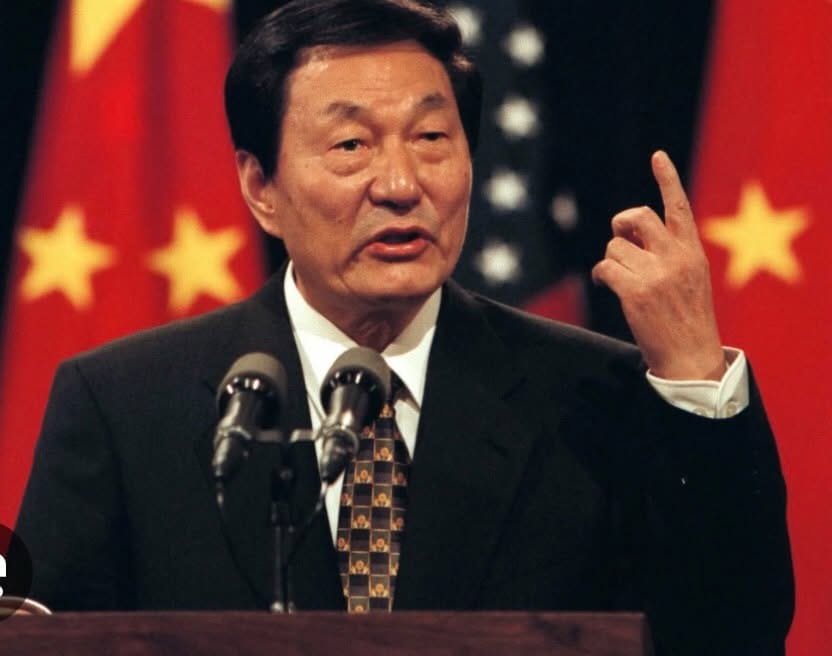
BEIJING, Aug 12 (Bernama-Xinhua) — Former Chinese premier Zhu Rongji died of illness at the age of 98 in Beijing at 11:06 am Wednesday, reported Xinhua.
Zhu had served as a member of the Standing Committee of the Political Bureau of the 14th and 15th Central Committees of the Communist Party of China (CPC).
An obituary, jointly issued by the CPC Central Committee, the Standing Committee of the National People’s Congress, the State Council and the National Committee of the Chinese People’s Political Consultative Conference, extolled Zhu as an excellent Party member, a time-tested and loyal communist fighter, and an outstanding proletarian revolutionist, statesman and leader of the Party and the state.
Zhu was born in October 1928 in Changsha, central China’s Hunan Province. He studied in the Department of Electrical Engineering at Tsinghua University from 1947 to 1951. He joined the CPC in October 1949.
From 1951 to 1983, Zhu worked at various places and held a series of posts related to economic affairs in regional and central government departments and institutions. He served as deputy director of the now-defunct State Economic Commission from 1983 to 1987.
Between 1987 and 1991, Zhu served successively as deputy secretary of the CPC Shanghai Municipal Committee, mayor of Shanghai and secretary of the CPC Shanghai Municipal Committee, where he pushed for industrial restructuring, stronger international competitiveness and an export-oriented development path. He was appointed vice premier of the State Council in 1991 and, in October 1992, became a member of the Political Bureau of the CPC Central Committee and its Standing Committee, taking charge of the State Council’s day-to-day work. In June 1993, he concurrently became governor of the People’s Bank of China.
He actively championed the implementation of the principles outlined in Deng Xiaoping’s remarks during Deng’s 1992 southern China tour and worked hard to promote reform and opening up as well as China’s modernisation drive.
He organised campaigns to resolve the problem of debt chains known as the “triangular debts.”
Also, he studied and developed approaches and measures to strengthen and improve macroeconomic regulation, making significant and effective contributions to curbing an overheated economy, reining in inflation and achieving an economic “soft landing.”
In September 1997, Zhu was re-elected a member of the Political Bureau of the CPC Central Committee and its standing committee and in March 1998, he was appointed premier of the State Council. Facing the impact of the Asian financial crisis and the catastrophic flooding in China, he implemented the plans of the Party Central Committee to shift from a moderately tight fiscal and monetary policy to a proactive fiscal policy and a prudent monetary policy, expand domestic demand and deepen reforms in key areas, thereby sustaining steady and rapid economic growth.
Zhu worked to establish the basic living security system for laid-off workers from state-owned enterprises, the unemployment insurance system, and the minimum living guarantee system for urban residents. He also made great efforts to address issues such as wage arrears and the re-employment of laid-off workers.
During Zhu’s tenure as vice premier and premier of the State Council, China was in a critical period of transitioning from a planned economy to a socialist market economy.
He also promoted the establishment of the basic framework for a socialist market economy, oversaw the completion of the arduous negotiations for China’s accession to the World Trade Organisation, and advanced the country’s opening up in both scope and depth.
He stressed the need to take the initiative, with a strong sense of responsibility, to shoulder heavy burdens, take on tough problems and go all out to deliver real results for the people, it added.
In March 2003, Zhu no longer served as premier of the State Council.
After retiring from leadership posts, he steadfastly upheld and supported the CPC Central Committee with Hu Jintao as general secretary, and then the CPC Central Committee with Xi Jinping at its core. He continued to care about the great cause of socialism with Chinese characteristics and firmly supported efforts to improve conduct, promote integrity and fight corruption.
Zhu’s life was a revolutionary, fighting and glorious one. His death is a great loss to the Party and the state, the obituary said.
–BERNAMA-XINHUA