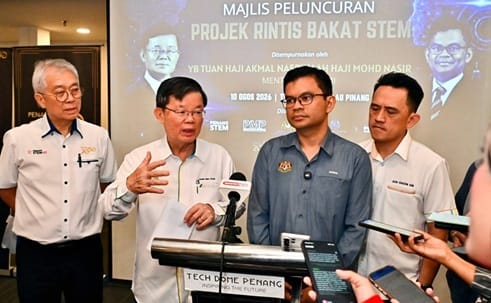
Chow Kon Yeow (2nd from left) and Akmal (3rd from left) Image Credit: Chow Kon Yeow FB
By C. Khor
GEORGE TOWN, Aug 12: The federal government will allocate RM12.3 million to strengthen Penang’s STEM talent pipeline, with a pilot programme targeting more than 100,000 students from rural areas and lower-income communities between 2026 and 2030.
Economy Minister Akmal Nasrullah Mohd Nasir said the STEM Talent Pilot Project, a collaboration between the Economy Ministry and Penang government, would build on the Penang STEM Talent Blueprint introduced in 2024.
“RM12.3 million will be channelled to support this programme until 2030,” he said at the launch of the project at Tech Dome Penang on Tuesday (Aug 10).
He said the initiative would adopt a whole-ecosystem approach involving the government, agencies, schools and industry, with Penang’s established semiconductor and electrical and electronics (E&E) ecosystem providing a strong foundation for the pilot.
“Penang has an advantage in terms of its ecosystem, in terms of semiconductors, as well as electrical and electronics.
“Promoting interest in STEM requires a comprehensive approach involving the whole ecosystem, not just the government or agencies, but also industry players,” he said.
The programme covers STEM education, mathematics, artificial intelligence and technical skills, giving students at different stages of schooling hands-on exposure to emerging technologies and pathways to high-value careers.
Akmal said the pilot would also address talent requirements of industries in Penang and support Malaysia’s broader push towards high-growth, high-value sectors. He said it was aligned with the 13th Malaysia Plan, New Industrial Master Plan 2030 and National Semiconductor Strategy, including the national target of developing 60,000 Malaysian engineers in chip design, advanced packaging and research and development.
He said the strength of Penang’s existing industrial ecosystem had contributed to the decision to use the state as a pilot location, with the model potentially being expanded to other states and economic sectors after its success is evaluated.
Meanwhile, Chief Minister Chow Kon Yeow said the five-year allocation reflected federal government support for Penang’s efforts to strengthen STEM education and talent development.
“The state government thanks the Economy Ministry for welcoming the STEM Blueprint launched in Penang. Over five years until 2030, RM12.3 million is channelled to support this blueprint through four streams,” he said.
Chow said Penang had already been running various STEM initiatives to prepare high-skilled talent for industry needs, with collaboration from industry players enabling more student placement programmes.
He said one of the programme’s key aims was to open a pathway for students to enter the workforce upon completing SPM, particularly in technical and STEM-related fields, with preparation beginning as early as Form Four.
“Some of our aspiration is that when students finish SPM, they can already start working because this programme prepares them from Form Four onwards.
“So they can go straight into industry if they choose, and if they can further their studies to a higher level, they will continue their education,” he said.
Akmal highlighted that Penang’s economy grew 7.3 per cent in 2025 against national growth of 5.2 per cent, with the manufacturing sector expanding 10 per cent%, gross domestic product reaching RM130.3 billion, and the state accounting for 48.9 per cent of Malaysia’s total exports in June.
“Previously, we were proud when we managed to produce goods that were ‘Made in Malaysia’, but now we want to change that to ‘Created by Malaysia’,” he said.
He said the objective was not merely to attract factories but to ensure Malaysia developed its own talent capable of creating higher value.
Separately, Akmal said the Economy Ministry was at the final stage of screening development expenditure proposals for Budget 2027 before submitting recommendations to the Finance Ministry.
He said the process was expected to be completed by mid-August as part of preparations for the Second Rolling Plan under the 13th Malaysia Plan.
“We are looking at new allocations that need to be recommended while also reviewing ongoing projects,” he said.
Akmal said the proposals would take into account infrastructure and facility requirements as well as the readiness of government agencies, while seeking to accelerate Malaysia’s move towards high-growth, high-value industries.
WE