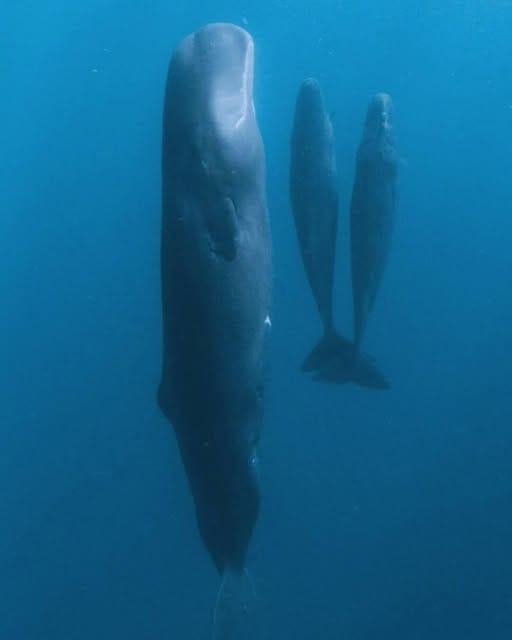
LONDON, July 24 (Bernama-PA Media/dpa) — Scientists have discovered that sperm whales are able to hang vertically in the water while sleeping by releasing gas bubbles that regulate their buoyancy, PA Media/dpa reported.
The whales’ resting behaviour was first documented by naturalists in 2008. They are the only whale species known to rest in a head-up vertical posture.
It is thought maintaining a position just below the sea surface buffers the whales from surface wave action, helping them to sleep better – while avoiding the energy needed to dive to deeper depths.
However, until now it has always been unclear how they maintain their position just below the surface while apparently asleep.
In a new study, scientists at the University of St Andrews and Universite de Neuchatel in France have discovered they do so by releasing gas bubbles, which they said helps the animals retain a neutral buoyancy.
Patrick Miller, from the Sea Mammal Research Unit at the University of St Andrews, said the challenge was regulating the whales’ natural buoyancy, which comes from gases in their bodies.
“By releasing air, that’s going to decrease the positive buoyancy of the animal, which will slow it from going up towards the surface,” he explained.
He said when the whales initially dive down to a resting depth they are head-down, but that they “slowly rotate to be head up” due to the spermaceti oil in their heads, which is much lighter than the rest of their bodies.
He continued: “Then, initially, the animals are still slowly moving up towards the surface once they spin to this vertical position.”
“And the way that they combat that is by blowing bubbles. So, each time they release a bubble, the analysis was able to show how that slowed the ascent towards the surface, helping the animal stay just beneath the surface.”
Since they have to come to the surface to breathe, each “resting dive” lasts 20 minutes or so, with the animals typically completing a number of resting dives in succession.
The team collected data for the study by placing small tags using suction cups on sperm whales off the Norwegian coast.
The tags, which record sound and 3D animal movements, captured clear bubble sounds, while animal movement data was used to create a simulation based on tissue density, drag through the water, and gas volumes in the animals’ bodies.
The simulation confirmed that the release of bubbles served to reduce the whales’ positive buoyancy, enabling them to remain submerged while resting.
Miller said the gases likely accumulate in the whales’ bodies from their deep dives in search of prey, when they can spend as long as an hour at depths of as much as 2,000 metres beneath the surface.
“They’re literally holding their breath the entire dive,” he said.
“Some of the gasses that will be produced during the dive will be carbon dioxide, which releases quite slowly from the body, and nitrogen, which is known to build up under pressure.”
The team said long foraging dives, or a series of such dives, can result in a “gas exchange deficit” in the whales’ bodies, and that “off-gassing” while in their resting state could also serve as a way of balancing this out.
It is not known whether any part of the whale needs to be awake for them to regulate their buoyancy in this way, and Miller said further studies of the whales’ brain waves – or even their “eye state” while they are resting – would be needed.
— BERNAMA-PA MEDIA/dpa