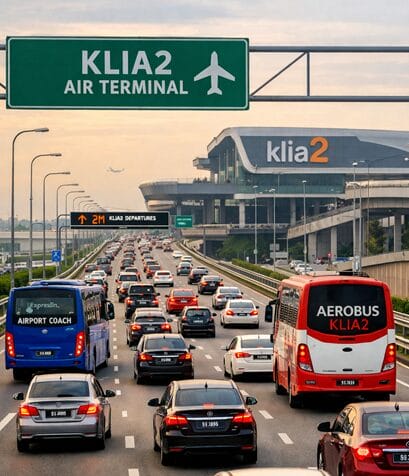
Image Creation Credit: Copilot
By Dr Rahim Said
There is an old saying in journalism that one should never expect applause for merely pointing out what is wrong. Our task is not to be liked. It is to notice what others have stopped seeing.
Earlier this week, Weekly Echo published a commentary by this writer on what many regular travellers at KLIA2 had quietly accepted as one of those uniquely Malaysian inconveniences: two empty VIP lanes sitting idle while ordinary motorists queued patiently to drop off family members, elderly parents and young children.
It was a small issue in the grand scheme of national affairs, but it symbolised something larger — the perception that convenience belonged to the privileged while inconvenience belonged to everyone else.
Then something unexpected happened.
Shortly after publication, our editor received a message from Malaysia Airports Holdings Berhad (MAHB). It read:
“Happy to read this feedback on the same week we opened up the VIP lane after months of negotiations with PDRM (Polis Di Raja Malaysia).”
That brief note deserves recognition.
It tells us two important things. First, the problem had not been ignored. Behind the scenes, MAHB had apparently been engaged in lengthy negotiations with the police to resolve the matter.
Secondly, it demonstrated something that deserves far more appreciation than it usually receives: someone within the organisation was actually listening.
In recent months, MAHB has endured more than its fair share of criticism. Airports are among the most visible public spaces in the country. Every delayed queue, every malfunctioning facility and every operational hiccup quickly becomes front-page news or viral social media content. Praise, unfortunately, rarely travels as fast as complaints.
That is why credit should be given where it is due.
Opening the previously restricted lane may not rank alongside building a new terminal or launching a billion-ringgit infrastructure project. Yet for thousands of motorists dropping off passengers every single day, it is precisely these seemingly modest improvements that define the travelling experience.
Good public administration is often measured not by grand announcements but by the removal of unnecessary frustrations.
What makes this episode especially encouraging is the relationship it reflects between the media and public institutions. Journalism should never become cheerleading, but neither should it become permanent cynicism. When legitimate criticism produces constructive change, everyone wins.
The public wins because services improve. The agency wins because it demonstrates responsiveness. The media wins because it proves that responsible reporting can make a tangible difference.
And Malaysia wins because institutions become just a little more accountable.
One hopes this spirit continues. If months of negotiations were required to achieve this seemingly simple adjustment, then those efforts deserve acknowledgement. Bureaucratic obstacles are rarely visible to the public, but overcoming them often requires persistence that goes unnoticed.
Weekly Echo is therefore delighted to record this positive development. It is gratifying to know that thoughtful feedback can contribute, however modestly, to improving the daily lives of ordinary Malaysians.
This is not an invitation to lower our standards. On the contrary, it reinforces them. We shall continue to observe, question and comment whenever public interest requires it. Praise, like criticism, must always be earned.
On this occasion, MAHB has earned it.
May this serve as a reminder that responsive institutions need not fear constructive criticism. Sometimes the most valuable headline is not about failure, but about improvement. In an era where bad news dominates public discourse, it is refreshing to report that common sense has prevailed, cooperation has succeeded, and travellers are the beneficiaries.
If this is the beginning of a more responsive culture at MAHB, then we at Weekly Echo are happy to have played a small part in the journey.
After all, journalism is not merely about exposing problems. It is also about celebrating solutions when they arrive.
The views expressed here are entirely those of the writer
WE