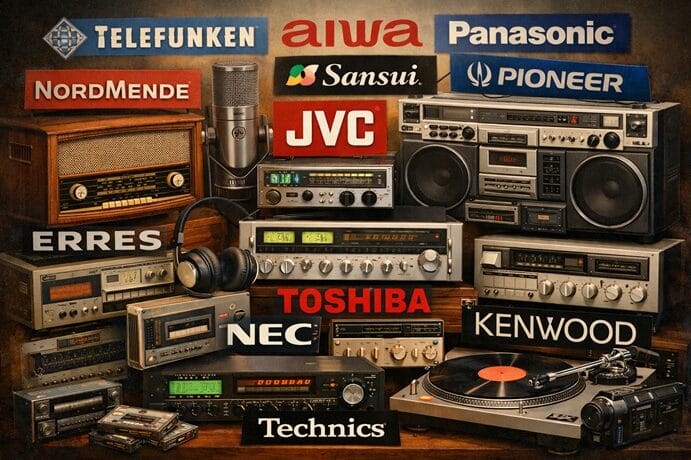
Yong Soo Heong looks into heritage brands that are still very much with us
From the warm glow of Sansui amplifiers to the precision of Telefunken microphones, from Panasonic’s Technics turntables to Pioneer’s car audio breakthroughs, the world once pulsed to the rhythm of these European and Japanese audio icons.
Today, many of those names survive only as licensed labels on Bluetooth speakers or budget soundbars, while others thrive in car audio or studio gear. This article traces their rise, fall, and revival — showing how heritage brands became memories, and why nostalgia still powers their resonance in our listening lives.
Echoes of Sound — When Audio Icons Became Memories
There was a time when the name on your amplifier or radio was more than branding. It was a statement of identity, of taste, of belonging to a global community of listeners. From Berlin to Tokyo, Eindhoven to Osaka, audio brands once defined how we experienced sound.
Today, many of those names survive only as echoes — licensed trademarks stamped on Bluetooth speakers or budget soundbars. Yet their stories remain instructive, reminding us how technology, economics, and nostalgia intertwine.
The Golden Age: Craftsmanship and Prestige
In the 1950s through the 1970s, audio was not just utility; it was aspiration. German firms like Telefunken and Nordmende built radios and televisions that embodied precision. Telefunken’s U47 microphone became immortal in studios, capturing Sinatra’s croon and The Beatles’ harmonies. Nordmende radios were family fixtures, reliable companions in post‑war Germany. Dutch Erres filled homes with affordable sets, less glamorous but no less essential.
Across the seas, Japan was rising. AKAI and Nakamichi were the crème de la crème for tape decks. Sansui amplifiers, especially the AU‑series, became cult objects for audiophiles, delivering warm, muscular sound. Aiwa pioneered portable cassette decks, rivalling Sony’s Walkman. Kenwood and JVC pushed stereo receivers and car audio into mainstream households, while Pioneer innovated relentlessly, from car CD players to home hi‑fi systems.
Toshiba carved a niche in portable radios and boomboxes, while National (Panasonic) became a household giant, its Technics sub‑brand producing turntables that remain benchmarks today. Even NEC, better known for computing, dabbled in amplifiers and speakers, reflecting Japan’s broad ambition in consumer electronics.
Owning these brands was a mark of taste. “Made in Germany” or “Made in Japan” meant craftsmanship, reliability, and prestige.
Expansion and Competition: The 1980s–1990s
By the 1980s, audio had become mass‑market. Japanese brands surged globally, while European names struggled. Pioneer and Kenwood dominated car audio. Aiwa’s boomboxes became youth culture icons. JVC conquered video with VHS but also produced headphones and stereos. Sansui retained audiophile respect but faced financial strain. Telefunken and Nordmende lost ground to Japanese imports, while Erres retreated into appliances.
Toshiba produced popular boomboxes and portable CD players, competing with Sony and Aiwa. National transitioned to the global Panasonic brand, becoming a giant in TVs and audio systems. NEC diversified into computing and communications, gradually exiting consumer audio.
The competition was brutal. Sony, Panasonic, and Philips leveraged scale and marketing, squeezing smaller brands. By the 1990s, many heritage names were fading.
Collapse and Consolidation: The 2000s
The new millennium brought decline. Blaupunkt, Bosch’s jewel in car audio, was sold in 2008, went bankrupt in 2015, and became a licensing brand. Sansui disappeared from high‑end audio. Aiwa was absorbed by Sony and discontinued. Telefunken and Nordmende survived only as licensed names. Erres became a discount appliance label. Kenwood and JVC merged into JVCKENWOOD Corporation. Pioneer exited home electronics manufacturing. Toshiba scaled back audio, focusing on computing. Panasonic consolidated under its global brand, continuing audio but shifting toward home theatre. NEC exited audio entirely.
The artisanal hi‑fi era was over. Globalisation and cheap Asian manufacturing reshaped the industry.
Revivals and Reinventions: 2010s–2020s
Yet heritage proved too valuable to abandon. Licensing firms revived these names for modern markets.
Aiwa returned with Bluetooth speakers, soundbars, and smart TVs. Sansui reappeared with portable speakers and karaoke systems. Telefunken split identities: Telefunken Elektroakustik in the U.S. hand‑builds studio microphones, while licensed Telefunken TVs and soundbars sell in Europe and Asia.
Nordmende carved a niche in digital radios and retro audio. Kenwood thrived in automotive audio, launching flagship receivers with wireless CarPlay. JVC pivoted to lifestyle audio — headphones, Bluetooth speakers, soundbars.
Pioneer debuted the world’s first aftermarket Dolby Atmos receiver in 2026. Toshiba remains present in portable audio and TVs, though less dominant. Panasonic continues producing high‑quality audio gear, with Technics turntables still revered. NEC has no audio revival, focusing entirely on IT.
These revivals leaned on nostalgia. Products were affordable, stylish, and mass‑produced, but they carried echoes of heritage.
2026: The Landscape Today
Still producing: Nakamichi, Pioneer, Kenwood, JVC, Aiwa, Sansui, Telefunken, Nordmende, Panasonic, Sharp, Toshiba. Lifestyle focus: Bluetooth speakers, soundbars, car audio. Licensed heritage: Blaupunkt, Telefunken, Nordmende, Erres. True hi‑fi holdouts: Telefunken Elektroakustik microphones, Technics turntables, vintage Sansui and Pioneer gear.
Absentees today: NEC in audio, Erres in hi‑fi.
In Malaysia, some distributors still carry Aiwa, Sansui, Kenwood, JVC, Panasonic, and Clarion products. Telefunken and Nordmende are rarer imports. Vintage Sansui amplifiers, Pioneer receivers, and Technics turntables remain cult favourites among collectors.
Heritage as Commodity
What does this tell us? That audio heritage has become a commodity. Names once synonymous with craftsmanship are now marketing assets, licensed to OEMs producing lifestyle electronics. The blue dot of Blaupunkt, the warm glow of Sansui, the prestige of Telefunken — all survive, but as echoes.
This is not necessarily tragic. Affordable nostalgia allows younger generations to access heritage brands. A Sansui Bluetooth speaker may not rival an AU‑717 amplifier, but it carries the name into new households. A Telefunken soundbar may not match a U47 microphone, but it keeps the brand alive.
Yet something is lost. The artisanal spirit, the pursuit of sonic perfection, the pride of ownership — these cannot be licensed. They belong to the golden age, when engineers obsessed over circuits and consumers cherished analogue warmth.
Memory, Heritage, Identity
The story of these brands is a cycle of innovation, decline, and revival. European names survive as licensed labels. Japanese audio brands remain active, though repositioned. NEC has made its exit.
For collectors, vintage units remain treasures — Sansui amplifiers, Telefunken microphones, Pioneer receivers, Technics turntables. For everyday consumers, modern revivals offer affordable nostalgia.
These names remind us that sound is not just technology. It is memory, heritage, and identity. The echoes of Telefunken, Nordmende, Erres, Nakamichi, Sansui, Aiwa, Kenwood, JVC, Pioneer, Toshiba, Panasonic, and NEC still resonate. They may no longer define the cutting edge of hi‑fi, but they continue to shape how we listen, reminding us that every brand carries a story — of innovation, of decline, and of rebirth.
WE