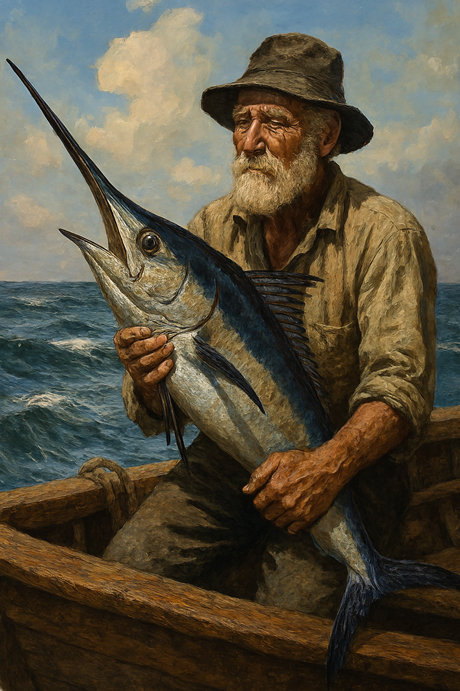
Image Credit: Copilout
By Dr Rahim Said
It is 2026. By December, I will be uncomfortably close to eighty.
At this age, one begins to realise that ageing is not something that suddenly happens to you; it is someone you have been living with all along.
Like an old tenant who moved in quietly decades ago, borrowed your energy, rearranged the furniture of your body, and is now firmly in charge of the house.
On this New Year’s Day, with the noise of fireworks replaced by the creaking of knees, I find myself thinking of another old man — Santiago, from The Old Man and the Sea.
Hemingway’s fisherman has been with me too, for most of my life. And as the years pile up, I find I understand him less as literature and more as autobiography.
Hemingway’s novel is a small book with an enormous soul. On the surface, it is almost offensively simple: an old fisherman, a long dry spell, one great fish, and a losing fight against sharks.
Yet this simplicity is its deception.
Like life itself, it looks straightforward until you are forced to live it.
Santiago has gone eighty-four days without catching a fish. The village has quietly judged him. That is how society works: it smiles politely while filing you under past usefulness.
Only the boy, Manolin, still believes in him. Youth, thankfully, has not yet learned the art of polite abandonment.
On the eighty-fifth day, Santiago sails farther out than usual. Not in anger. Not in desperation. But in faith.
That detail matters. Old age, when done properly, is not about reckless hope or stubborn denial. It is about knowing your craft so well that you trust it even when the world has stopped clapping.
When Santiago hooks the marlin, the struggle that follows is not violent bravado but intimate endurance. His hands bleed. His back aches. He talks to himself, to the fish, to the birds, to the sea.
Anyone who has crossed seventy will recognise this monologue. The older you get, the more life becomes a conversation with pain — and a negotiation with dignity.
What strikes me most now is Santiago’s respect for the marlin. He calls it his brother. He admires its strength. This is not a man trying to conquer nature. It is a man meeting his equal. In youth, we want to win. In age, we want to be worthy.
The marlin, to me, is no longer just a fish. It is the sum of our ambitions — the career we chased, the ideals we clung to, the love we tried to protect. Many of us have, at some point, landed our marlin. And many of us have watched sharks take it apart on the journey home: illness, politics, betrayal, time. The older you get, the less shocking this becomes.
The sea, Hemingway reminds us, is neither kind nor cruel. It simply is. This may be the most important lesson of all.
At twenty, we believe life owes us fairness. At forty, we suspect it doesn’t. At eighty, if we are lucky, we stop asking altogether. Acceptance is not resignation; it is clarity.
When Santiago returns with nothing but the skeleton of the great fish, the villagers finally see what he has done.
But by then, their opinion no longer matters. Santiago has already answered the only question that counts: Am I still myself?
“A man can be destroyed but not defeated,” Hemingway writes. That line hits differently when your body begins to betray you. Destruction is physical. Defeat is spiritual. One is often unavoidable; the other is optional.
And then there is Manolin — the boy. The future. The quiet reassurance that what we have learned, endured, and loved does not end with us.
Manolin’s loyalty is not sentimental; it is existential. He proves that meaning is not stored in outcomes but passed on through example.
In a world obsessed with results — profits, likes, medals, headlines — The Old Man and the Sea offers a radical, almost inconvenient truth: your worth is not measured by what you bring home, but by how bravely you sail out.
As I edge closer to eighty, I realise I have been living with my own Santiago all along. He wakes up slower now. He complains more. He has scars I don’t remember earning. But he still believes in the sea. He still respects the struggle. And most importantly, he still knows who he is.
On this New Year’s Day, that feels like enough.
Happy New Year