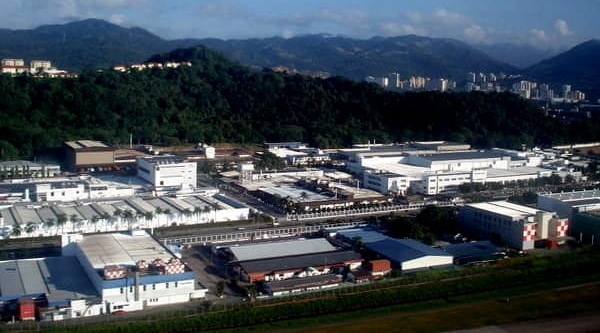
Penang’s “Silicon Valley” (Photo Credit: Bayan Lepas FIZ FB)
How a locally designed FPGA empowers edge intelligence, industry, and national autonomy
By Dr Mohd Safar Hasim
On Nov 5, 2025, Malaysia reached a technological milestone when its first domestically designed FPGA chip was powered on. This FPGA is more than a single engineering success: it is a technological, political, and civic statement.
Technologically, it demonstrates that Malaysia can move from being a global assembly and test hub to originating chip architecture.
Politically and civically, it signals growing capacity to author critical digital infrastructure rather than merely import or assemble it. The significance of this FPGA should be measured not only by transistor counts or process nodes, but by what the product enables for local industry, civic infrastructure, and the education pipeline.
At the heart of this moment is the Field Programmable Gate Array itself — a reprogrammable integrated circuit that implements custom logic after manufacturing. Unlike CPUs or GPUs, which follow fixed architectures, an FPGA’s hardware-level flexibility makes it ideal for deterministic timing, ultra-low latency, and specialised parallel I/O.
These are precisely the capabilities required in robotics, medical devices, smart infrastructure, industrial automation, and edge AI. In other words, this FPGA is the kind of hardware that quietly runs the real-time systems underpinning smart cities and resilient industry.
This particular FPGA was designed in Penang and validated locally; fabrication was carried out at advanced global foundries. The design work — the architecture, logic block layout, timing closure, and system integration — is the intellectual achievement to highlight.
The manufactured FPGA that arrived back in Malaysia is the tangible product of that design effort, and it is ready to be integrated into real-world systems that value predictability and energy efficiency over raw datacentre throughput.
What is an FPGA for, practically? The product shines where predictable latency, precise control, and on-device processing matter:
* Edge AI inference in smart cameras and drones, where sending data to the cloud is impractical or undesirable.
* Deterministic control loops in robotics and factory automation, where microsecond timing can make the difference between safe operation and failure.
* Telecom tasks such as packet processing and modulation accelerators in private 5G networks.
* Medical imaging pre-processing and instrumentation where bespoke signal chains and low jitter are required.
* Custom accelerators for domain-specific algorithms where power-per-operation and physical footprint matter.
Juxtaposed with mainstream products from Nvidia, AMD, or Intel, this FPGA occupies a different position in the landscape. To understand the differences, compare three dimensions: purpose, fabrication/node maturity, and ecosystem maturity.
* Purpose: Nvidia’s GPUs are engineered for high-throughput parallel workloads — massive matrix math for AI training and large-scale inference. AMD’s adaptive compute platforms and Intel’s advanced FPGAs aim to blend reconfigurability with hardened AI engines for telecom, data-centre offloads, and heterogeneous acceleration.
By contrast, the Malaysian-designed FPGA product targets embedded, industrial, and edge applications: precise I/O, low latency, and low power for specific deployed systems. It is not intended to replace datacentre GPUs; it is designed to enable deterministic edge intelligence.
* Fabrication and node maturity: Leading GPUs and some high-end adaptive compute devices use cutting-edge process nodes (5nm, 4nm) and advanced packaging to maximize transistor density, memory bandwidth, and power efficiency.
High-tier FPGAs from global vendors also use advanced nodes and multi-die approaches. The Malaysian FPGA product, by pragmatic design choices, is most likely fabricated on a mature mid-range node (for example, 28nm–40nm).
That choice reduces mask and fabrication costs, improves yield, and matches the performance/power window needed by embedded systems. Node size is not a simplicity marker here; it’s a deliberate trade-off to make the product appropriate, affordable, and reliable for its intended use cases.
* Ecosystem and software: Nvidia’s dominance rests not only on silicon but on an enormous developer stack (CUDA, libraries, pretrained models). AMD and Intel bring mature toolchains and partner ecosystems as well.
The FPGA product’s adoption will depend heavily on the available toolchain, IP blocks, driver support, reference designs, and documentation. The product’s technical success must be followed by investments in developer experience: board-level reference designs, compiler flows, and integration examples for target industries.
Is this FPGA advanced or ordinary? That depends on the metric:
* By raw datacentre metrics (matrix TFLOPS, memory bandwidth, wafer-scale packaging), it is not comparable to Nvidia’s H100-class accelerators or AMD/Intel flagship devices. Those chips are optimised for model training at scale and require the most advanced lithography and packaging solutions.
* By contextual and strategic metrics, the FPGA is advanced: it demonstrates a full-cycle capability — architecture, RTL development, verification, and a successful tape-out and power-on. For Malaysia’s industrial requirements, the product is potentially best-in-class: tuned for latency, power budget, and deterministic behaviour rather than headline compute numbers.
Practical implications of this product-level achievement are concrete:
* Cost-effectiveness and time-to-first-silicon: Choosing a mature node reduces development cost and accelerates iterations, making the product accessible for local manufacturers and integrators.
* Fit-for-purpose performance: For embedded inference and control, latency and power per operation are often more important than raw throughput; the FPGA can be optimised toward those metrics.
* Capability building: The real economic return will come from ecosystem growth — training engineers in RTL and system integration, building local reference platforms, and forming partnerships with integrators and industry verticals.
Strategically and civically, the product matters. An indigenously designed FPGA anchors a domesticcapability: teaching RTL design, timing closure, verification rigor, and system co-design.
It gives educational institutions a concrete, local artifact to teach from; it provides policy makers a tangible example of industrial strategy; and it gives local firms a domestically supported component for critical systems, reducing single-source dependency for some classes of infrastructure.
In conclusion, the Malaysian-designed FPGA product is not a direct competitor to datacentre GPUs on the metrics those chips are built for.
Instead, it is a purposeful, contextually advanced product designed to serve embedded and industrial domains where predictability, reconfigurability, and power efficiency matter most.
Its ultimate success will be measured less by nanometres and more by how quickly the supporting tools, reference platforms, and industry partnerships mature to turn the FPGA from a technical milestone into sustained economic, educational, and civic value.